1. Linear Regulators vs. Switching Buck Regulators: When Does Efficiency Criticality Peak?
Engineers evaluating high-drop step-down circuits—such as dropping a 48V telecom bus or 24V commercial vehicle alternator line down to 12V or 5V—often calculate waste thermal footprints before making topology choices. A linear regulator (e.g., LDO) acts as a dynamic resistor, dropping voltage across its internal pass transistor. Its power dissipation directly follows the formula:
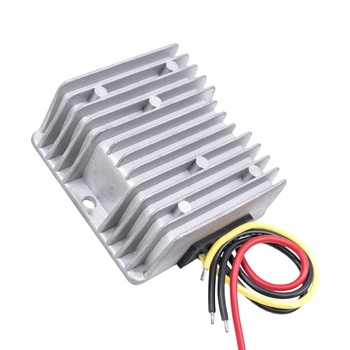
P_dissipated = (V_in - V_out) × I_loadIn a 24V down to 12V 20A configuration, a linear topology dissipates 240W of pure thermal loss while delivering 240W to the terminal load—an unacceptable 50% power efficiency that necessitates prohibitive forced convection equipment. A synchronous DC to DC buck converter from Varnix utilizes high-frequency MOSFET pulse-width modulation (PWM) combined with low-loss energy storage inductors, yielding over 95% efficiency, slash-cutting energy consumption, and operating reliably in completely sealed IP68 convection-cooled chassis.