Step Down Converter Manufacturer & Exporters serving Bruges
Industrial Galvanic Isolation, Synchronous Buck Topologies, and Extreme-Environment DC-DC Regulators Engineered for Maritime Automation, Electric Heavy Mobility, and Port Logistics Across Greater Bruges and Zeebrugge.
Engineered Equipment Portfolio
Featured Industrial Step-Down Converters & Power Systems
Field-tested synchronous buck converters, wide-input isolated DC-DC modules, and ultra-rugged voltage regulators optimized for North Sea coastal environments and industrial automation fleets in West Flanders.
Designing low-noise, high-reliability direct-current conversion for heavy duty logistics, commercial vessel sub-systems, and electrified transport hubs operating under volatile voltage conditions.
Complete Galvanic Isolation
Industrial step-down converters serving seaport logistics cannot risk ground loops between high-voltage battery banks (48V to 96V traction packs) and sensitive 12V/24V microcontrollers or communication transceivers.
Optically isolated feedback paths and planar transformers provide over 1500V DC breakdown isolation, suppressing high-frequency transient spikes during heavy motor braking.
This topology shields CAN-bus infrastructure, telematics units, and GPS navigation modules from high-current DC motor inductive kickback common in straddle carriers and automated terminal forklifts.
Synchronous Rectification Efficiency
Traditional buck converters suffer substantial forward-bias diode losses ($P_{loss} = V_F \times I_{out}$), which become unmanageable in high-amperage 42A–60A modules inside sealed enclosures.
By substituting ultra-low $R_{DS(on)}$ MOSFET switches for conventional Schottky diodes, our converters achieve peak electrical efficiency surpassing 95.5%.
Bruges and the coastal port facilities of Zeebrugge subject electronic hardware to aggressive marine saline humidity, rapid thermal cycling, and continuous mechanical vibration from rail and road freight.
High-grade polyurethane vacuum potting protects every SMPS component against salt fog, sulfurous air contamination, and mechanical shocks up to 10G.
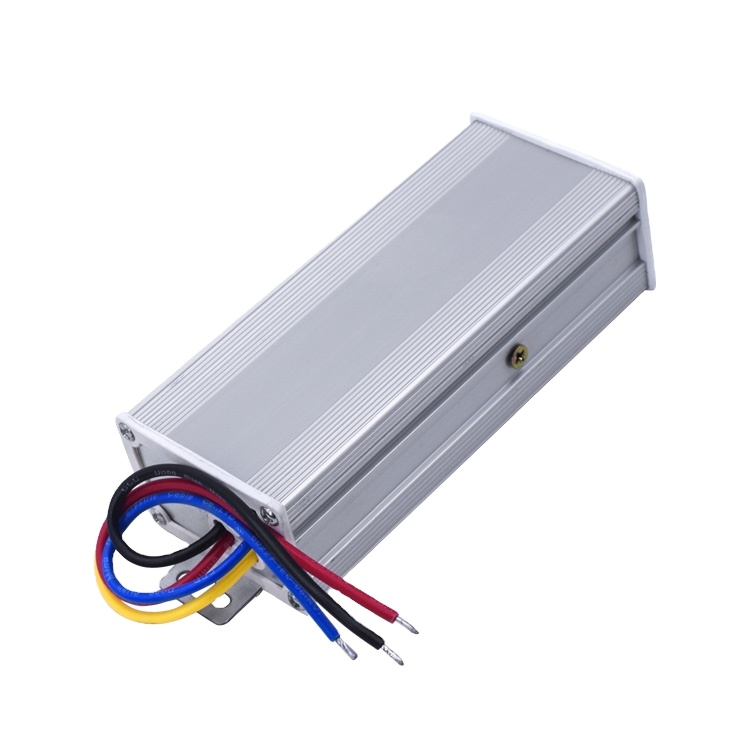
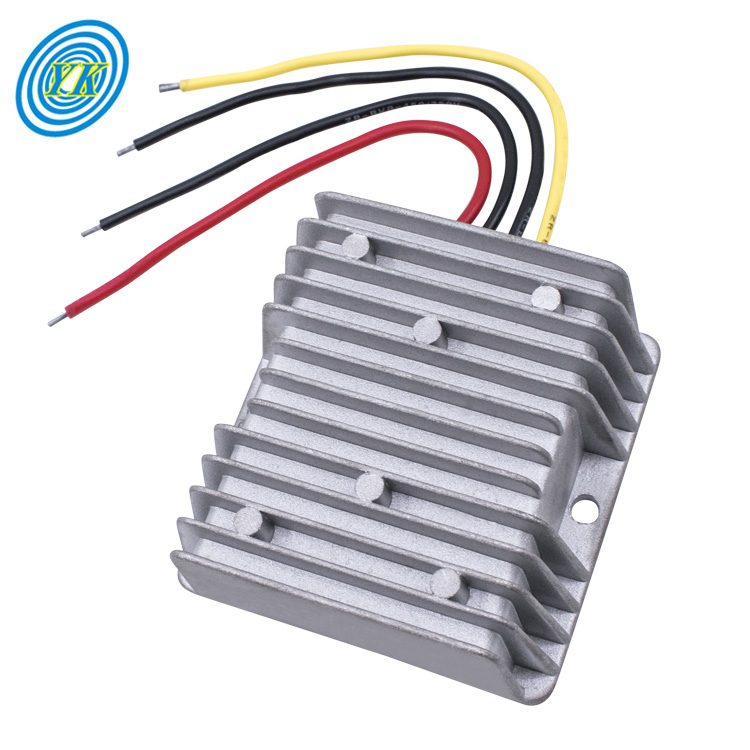
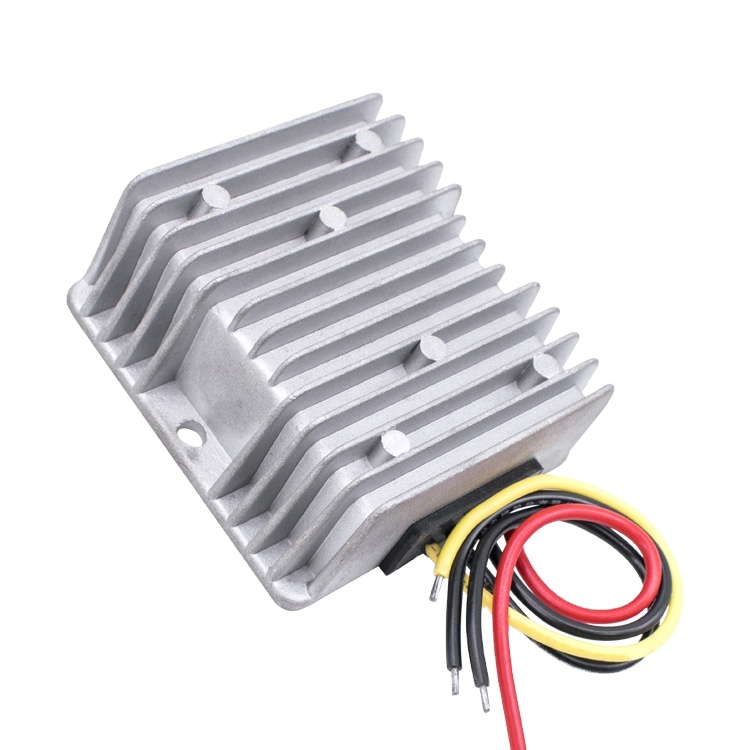
Anodized aluminum alloy housings act as unified heat sinks with corrosion-resistant finishes tested rigorously according to European standards for moisture and salt fog ingress.
Geographic Application Matrix
Power Conversion Applications across Bruges & Port of Zeebrugge
Bridging the voltage divide between advanced energy storage systems and mission-critical low-voltage control hardware across Belgium’s preeminent maritime and multimodal hub.
Zeebrugge Port Terminal Automation & Heavy AGVs
The Port of Antwerp-Bruges is one of the world's most sophisticated roll-on/roll-off (Ro-Ro) cargo centers and a primary European gateway for container logistics. Operating automated terminal trucks, reach stackers, and automated guided vehicles (AGVs) requires continuous stepped-down direct current from main propulsion battery systems (typically 48V, 72V, 80V, or 96V DC) down to 24V and 12V auxiliary rails.
LiFePO4 & Lead-Carbon Compatibility: Handles rapid voltage swings during regenerative dynamic braking without over-voltage trip outs.
Isolated Telematics Power: Powers onboard lidar, RTK-GPS positioning systems, and automated safety interlocks with zero common-mode ground interference.
Continuous Cold-Storage Reliability: Certified cold start operation down to -40°C for refrigerated logistics warehouses along the Bruges-Zeebrugge canal axis.
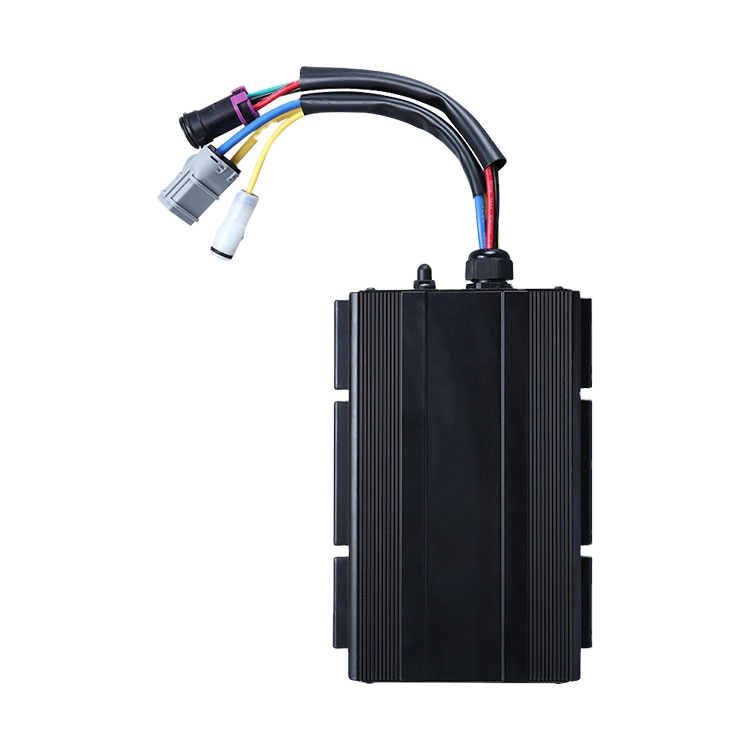
Our 500W and isolated 48V–96V step-down converters are purpose-built to survive heavy-duty shunting duty cycles, offering zero-maintenance uptime for logistics fleets.
Calibrated voltage stabilization profiles for marine buffer batteries
EN 61000-6-2/4
Industrial Heavy Immunity & Low Emission CE conformity verified
10G Shock
Mechanical integrity tested on heavy terminal rail transfer gantries
Inland Barges, Coastal Workboats & Offshore Wind Support
Bruges' extensive network of canals connecting to the North Sea demands electrified tugboats, pilot vessels, and inland freight barges. Marine auxiliary distribution requires stepping down 24V, 48V, or 110V direct-current lines to ultra-stable 12V and 13.8V DC rails for navigation radar, sounders, radio consoles, and emergency backup battery trickle maintenance.
Clean DC Power for Hydrographic Instruments: Integrated differential-mode LC filters eliminate switching hum from acoustic sonar and maritime VHF radios.
Offshore Wind Transfer Vessel (CTV) Auxiliaries: With Zeebrugge serving as a maintenance hub for Belgian offshore wind farms, ruggedized IP67 power units provide dependable performance under extreme pitch-and-roll vibrations.
Hydrogen Terminal Instrumentation: As Bruges expands its green hydrogen imports and carbon capture infrastructure, explosion-proof, non-sparking encapsulated converters offer compliance-ready integration.
Every converter exported to Flanders maritime integrators undergoes rigid multi-point testing to guarantee complete compliance with European marine low-voltage and EMC directives.
Procurement & Engineering Matrix
Comprehensive Specification & Selection Guide
Select the correct power topology based on input source fluctuation, isolation requirements, and target thermal loads in North European installations.
Target Subsystem
Recommended Topology
Nominal Input Range
Output Voltage & Current
Isolation Level
Protection Protocols
Electric Yard Tractors & Forklifts
Isolated Synchronous Buck
48V, 72V, 80V, 96V DC (40V–110V)
24V DC @ 2.5A to 20A
1500V DC Isolation
OVP, OCP, UVLO, Reverse Polarity
Port Automation Telematics & Vision
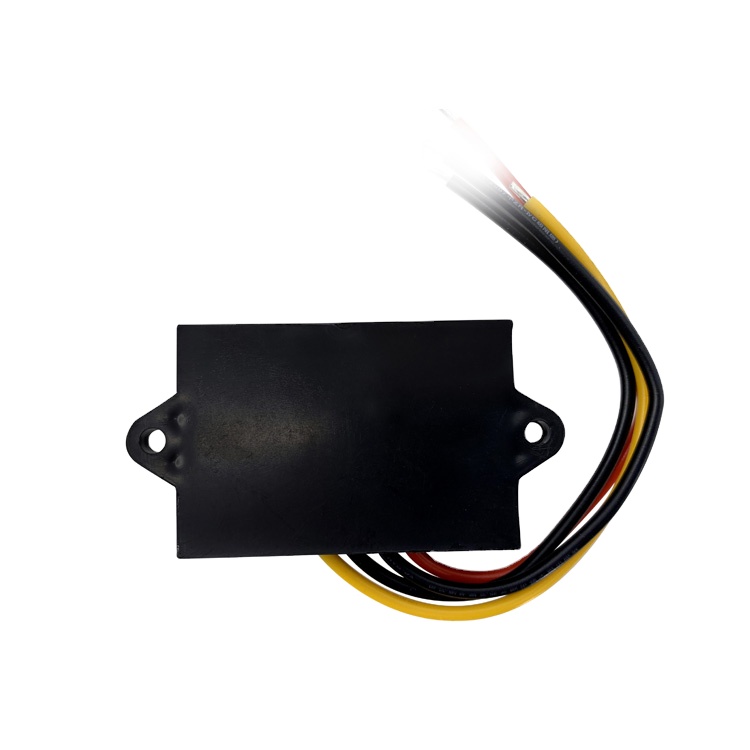
Sealed Non-Isolated Micro Buck
24V DC (18V–36V Extended)
12V DC @ 3A (36W)
Common Ground
Internal Thermal Cutoff, Short-Circuit
Barge & Tug Marine Control Panels
High-Wattage Isolated Buck Charger
48V–90V DC Battery Line
12V DC @ 42A (500W Max)
2000Vrms Dielectric
Soft Start, Constant Current Limiting
Maritime Communication & Navigation
Automatic Buck-Boost Stabilizer
8V–40V Wide Range DC
13.8V DC Regulated @ 5A / 10A
Non-Isolated Filtered
Ultra-Low EMI (CISPR 25 Class 3)
Harbor Pilot Portable Instrumentation
IP67 Hermetic USB Converter
12V / 24V DC (9V–32V)
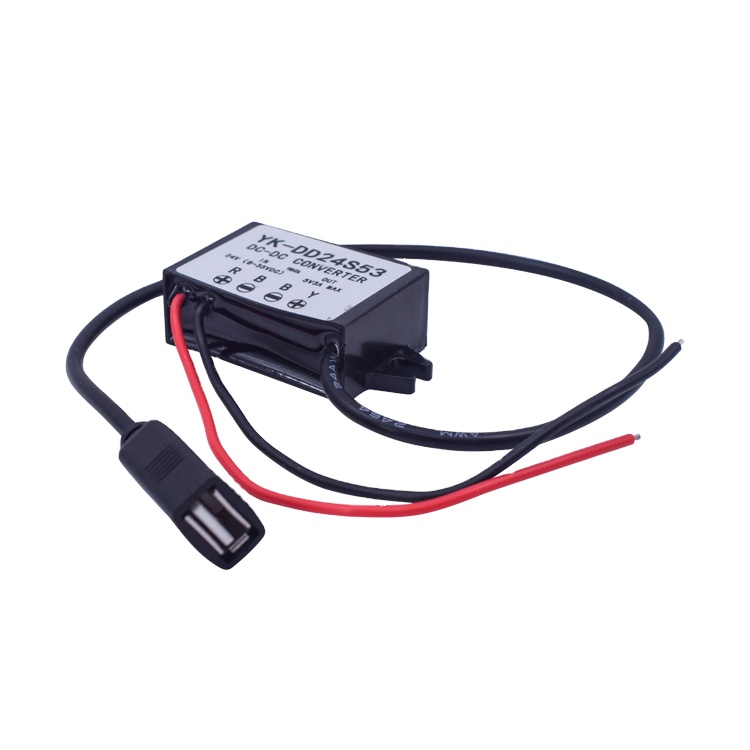
5V DC @ 5A (25W USB)
Common Ground
Transient Surge Suppressor, IP67
Terminal Maintenance Sub-Distributions
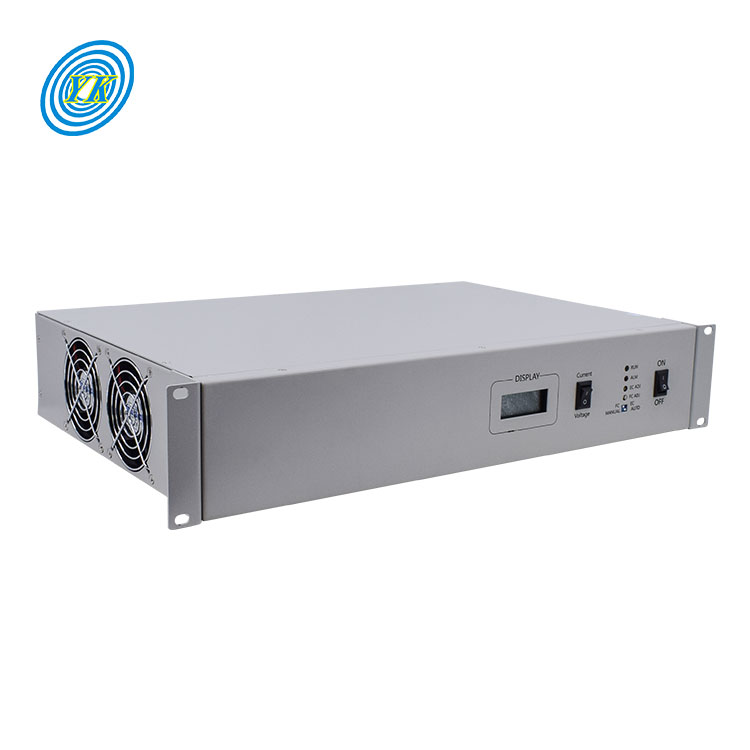
Active SMPS Industrial Rectifier
110V / 220V AC Single Phase
24V DC @ 10A to 100A
3000V AC Input/Output
Over-temperature, Active Power Factor
Thermal Derating Insight for Sealed Enclosures: When mounting non-ventilated IP67 encapsulated step-down converters within unventilated crane engine compartments or outdoor shore-power pedestals exposed to direct sunlight, allow a 20% continuous current derating factor above 50°C ambient to maximize capacitor and inductor longevity.
Since 2003, our Guangzhou manufacturing base has supplied over 1.2 million power conversion modules to industrial procurement teams across Western Europe and North America.
01
Incoming Component Screen
100% incoming validation of Rubycon/Nichicon long-life electrolytic capacitors, automotive-grade MOSFETs, and high-permeability magnetic cores against strict tolerances.
02
Precision SMT & Wave Soldering
Automated surface mount and robotic through-hole soldering lines operating under ISO 9001:2015 controls to prevent dry joints and solder bridging defects.
03
4-Hour Full-Load Burn-In
Every production unit is subjected to an exhaustive 4-hour dynamic burn-in test under 100% rated thermal and electrical load in our aging chamber to screen out early component mortality.
04
Hi-Pot & Oscilloscope Check
Rigorous dielectric insulation testing up to 2000V AC alongside digital storage oscilloscope analysis verifying that ripple and noise conform exactly to purchase contracts.
Procurement directors and technical buyers in Bruges require authenticated factory reliability rather than trading intermediaries. Our manufacturing campus has been verified onsite by SGS Group, confirming 10+ operational assembly and testing lines, certified working conditions, and complete traceability down to component batch levels.
We handle export documentation seamlessly, offering DDP (Delivered Duty Paid), CIF Port of Zeebrugge, or air freight express terms directly into Belgium with full EUR.1 and CE Declaration of Conformity dossiers.
Need a custom input voltage threshold (e.g., 60V–130V railway supply) or custom pinout wiring harness with TE Connectivity / Deutsch waterproof connectors? Our in-house R&D engineering division produces sample iterations within 7 to 14 business days.
Customized housing extrusions, specific mounting flanges, and laser-etched OEM branding.
Programmable constant current (CC) and constant voltage (CV) curves for specialized chemical battery banks.
Multi-channel outputs combining 24V industrial controls with 5V USB instrumentation feeds.
Regional Market Analysis
Electrification Trends Driving Power Conversion in Flanders
Analyzing technical shifts across West Flanders toward shore-to-ship microgrids, hydrogen terminal logistics, and ultra-high-efficiency DC distribution.
Shift toward Higher-Voltage DC Battery Buses
To mitigate $I^2R$ copper losses across large harbor mobile machinery, terminal equipment in Zeebrugge is migrating rapidly from legacy 24V and 48V banks toward 80V, 96V, and 120V nominal lithium systems.
This migration demands high-voltage step-down buck regulators with wide input ceilings (up to 120V peak) capable of maintaining tight 12V and 24V regulation despite rapid heavy dynamic load switching.
Shore-Power (Cold Ironing) & DC Microgrids
European Union maritime mandates dictate that commercial ships docked at Zeebrugge shut down auxiliary diesel generators and plug into clean shore electrical power by 2030.
Quayside battery storage systems, charging pedestals, and vessel berth connections rely on our rugged switching power rectifiers and step-down converters to power low-voltage monitoring and automated cable-handling systems.
Rigid EMI Compliance for Modern Telematics
Modern port logistics depends upon 5G private networks, RFID container tracking, and real-time remote crane control. Poorly shielded power supplies generate radiated electromagnetic interference that disrupts wireless telemetry.
Our converters feature internal common-mode choke coils, multi-stage pi-filtering, and shielded aluminum enclosures fully tested to European industrial and maritime EMC specifications.
Buyer & Engineer Advisory
Bruges Procurement & Engineering FAQ
Key technical and commercial answers for purchasing managers, electrical engineers, and systems integrators in Bruges and across Belgium.
What are the lead times and shipping terms for delivery to Bruges and Port of Zeebrugge?+
For standard catalog step-down converters and inverters, standard batch orders ship within 5 to 10 working days directly from our facility. Air freight delivery via Brussels Airport (BRU) or Ostend-Bruges International Airport (OST) typically arrives within 4 to 6 business days.
For large volume logistics or OEM container shipments, sea freight delivered CIF Port of Zeebrugge or DDP (Delivered Duty Paid) to your facility warehouse in Bruges takes approximately 28 to 34 days, including full customs clearance and EU VAT processing.
When must we select an Isolated step-down converter over a Non-Isolated module?+
Galvanic isolation is strictly mandatory when the input direct-current source exceeds 60V DC (such as 72V, 80V, or 96V traction batteries in heavy port AGVs or yard mules) to comply with the European Low Voltage Directive (LVD 2014/35/EU) and prevent shock hazards.
Furthermore, isolation is essential if your equipment interfaces with sensitive sensors, navigation radar, CAN-bus communication lines, or hydrographic measuring instruments where ground potential shifts or electrical transients would otherwise cause signal corruption or microcontroller latch-up.
How do your step-down converters withstand maritime salt fog and North Sea humidity?+
Our marine-grade step-down series feature full vacuum potting using high-thermal-conductivity polyurethane resin that totally envelops all semiconductors, inductors, and trace paths. This creates an impermeable seal rated to IP67 and IP68 standards, completely shielding delicate electronics from conductive saline moisture, coastal fog, and corrosive industrial atmospheres.
Chassis are constructed from high-grade die-cast or extruded 6063-T5 aluminum treated with an anti-corrosion passivation layer and stainless steel 304/316 exterior fasteners.
What CE, RoHS, and European compliance documentation is supplied with consignments?+
Every commercial consignment exported to Belgium is backed by genuine Declarations of Conformity (DoC) covering the EMC Directive 2014/30/EU (EN 61000-6-2 immunity, EN 61000-6-4 emissions) and Low Voltage Directive 2014/35/EU. Our manufacturing processes fully comply with RoHS 2011/65/EU and REACH regulations. SGS third-party laboratory test reports are provided upon project award.
Can your engineering team customize input/output voltages and connectors for custom fleets?+
Yes. As a primary manufacturer operating dedicated R&D labs, we frequently customize step-down voltage set points (such as adjusting 48V to a precise 13.8V for radio battery floating or 28V for aerospace ground power). We can integrate custom cable lengths, pre-crimped Deutsch DT connectors, Anderson Powerpole plugs, or specialized ruggedized military-spec connectors to streamline plug-and-play assembly on your production floor.
What protection features prevent damage from heavy inductive motor inrush?+
Our heavy-duty converters incorporate a multi-tier protective matrix: TVS (Transient Voltage Suppressor) diodes at the input stage clamp inductive load dumps and spikes; cycle-by-cycle over-current protection (OCP) limits peak current into high-capacitance downstream loads; and smart Under-Voltage Lockout (UVLO) ensures clean shutdown without erratic switching if the supply battery drops under heavy starter motor cranking.
What are your minimum order quantities (MOQs) for prototype testing versus volume contracts?+
For standard catalog models, our MOQ begins at just 1 to 5 units to facilitate engineering bench evaluation, vehicle prototyping, and field testing in Bruges facilities. For bespoke OEM/ODM designs requiring custom tooling or modified firmware, project evaluation batches typically commence at 50 to 100 units, with volume scheduled releases structured around your annual manufacturing schedule.
What warranty coverage and engineering post-sale support do you provide?+
All industrial step-down converters carry a comprehensive 12 to 24-month factory replacement warranty directly specified in trade agreements. Our English-speaking technical support engineers are available across European business hours to assist with schematic reviews, thermal dissipation planning, and integration troubleshooting via email and video conference.
Ready to Engineer Your Power Conversion Solution?
Consult directly with our senior power electronics team. Submit your input parameters, desired output amperage, mechanical enclosure requirements, and target timeline to receive an optimized engineering proposal within 24 hours.