23+
Years R&D Authority
96.8%
Peak Conversion Efficiency
10+
SMT & Assembly Lines
100%
Full-Load Burn-In Tested
IP68
Silicone Potting Ingress
4.7/5
Global Verified Rating
Engineered Power Supplies
High-Efficiency DC-DC Step-Down & Buck Regulators
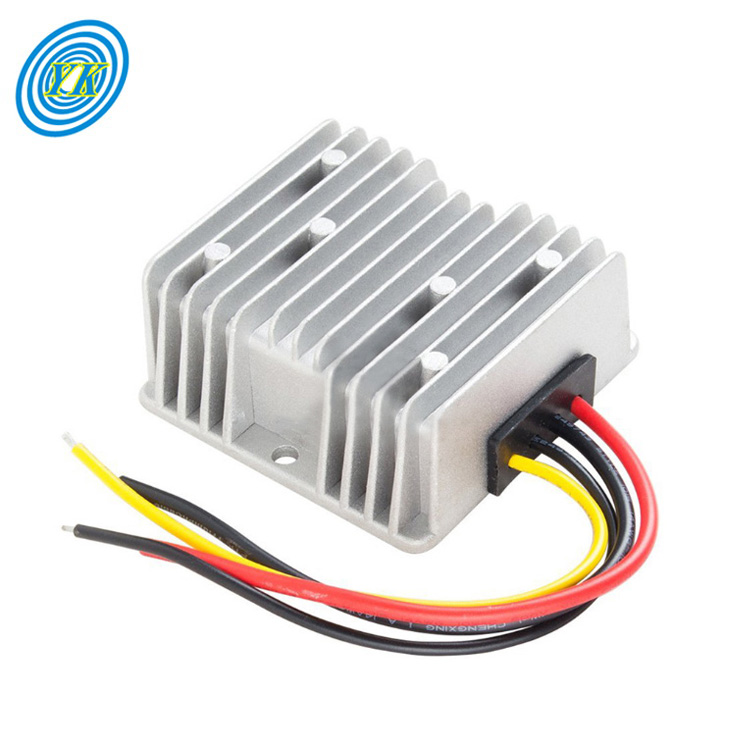
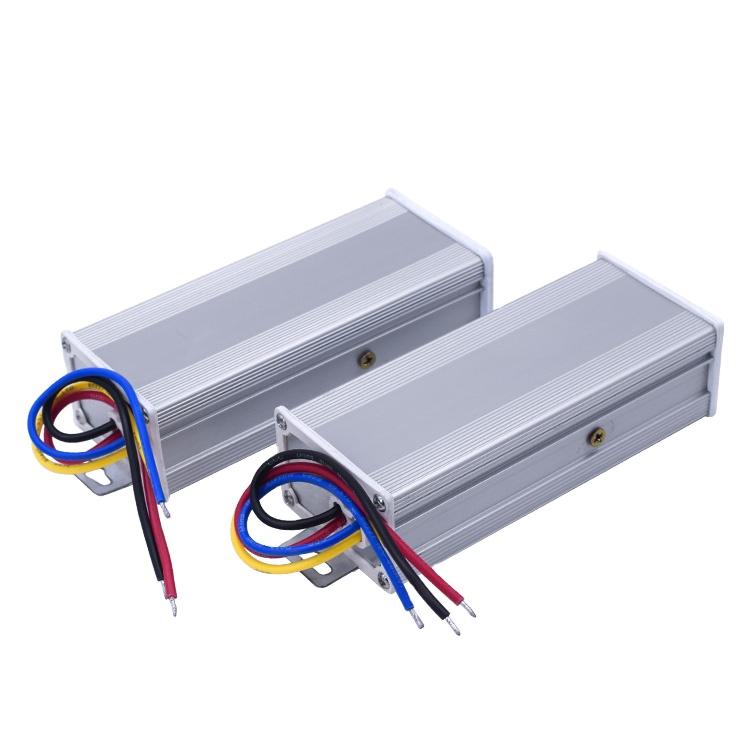
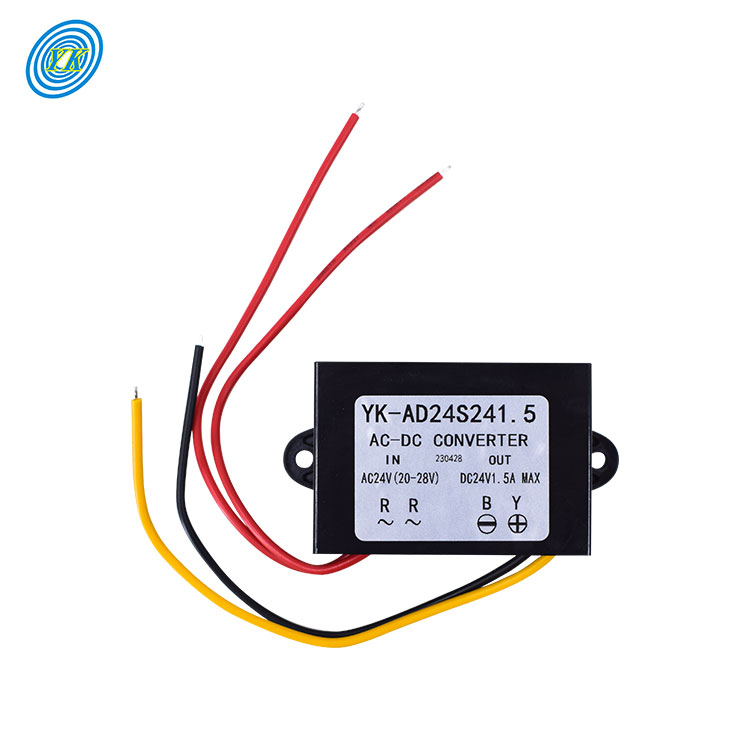
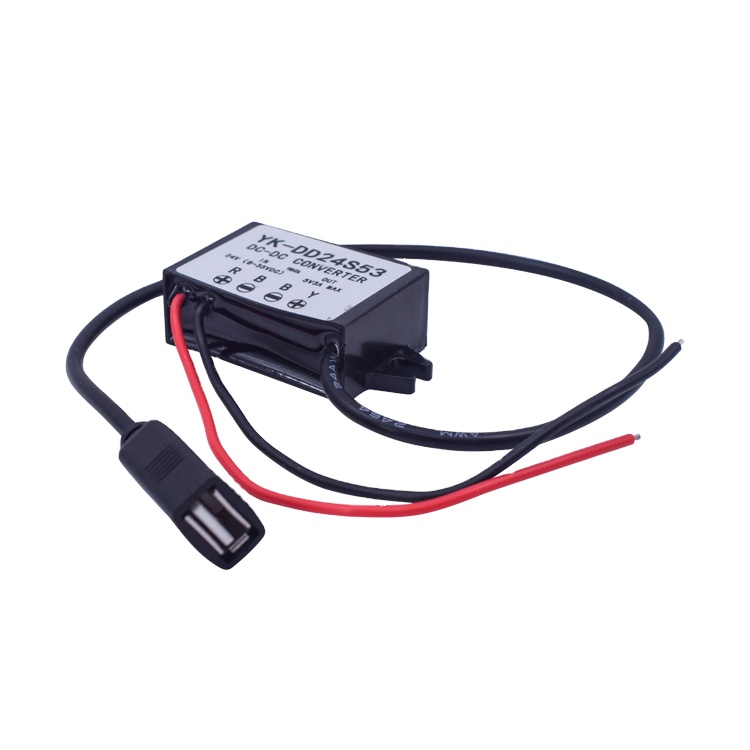
Explore our certified conversion lineup designed for rugged operating conditions. Built with high-grade planar magnetic inductors, ultra-low ESR solid capacitors, and comprehensive short-circuit / thermal foldback safety suites.
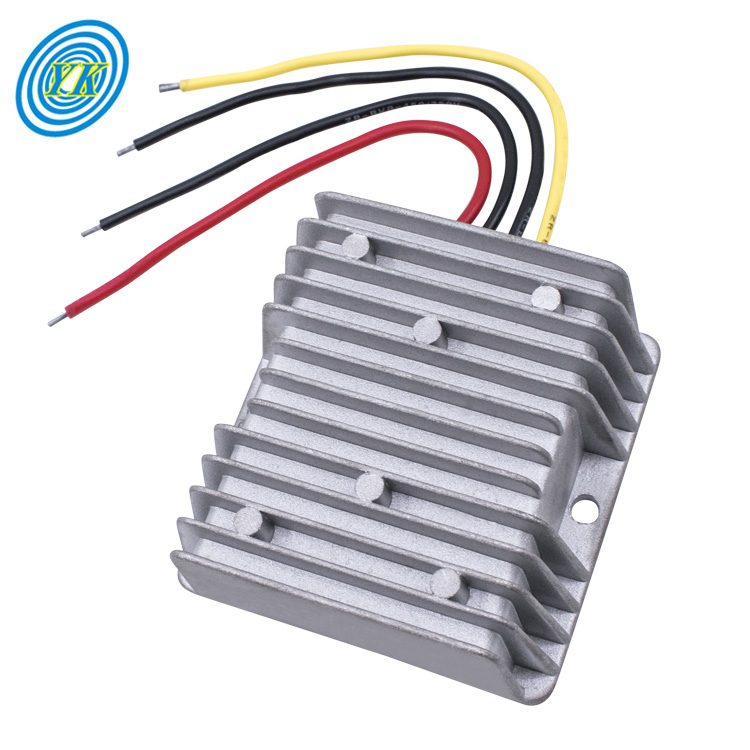
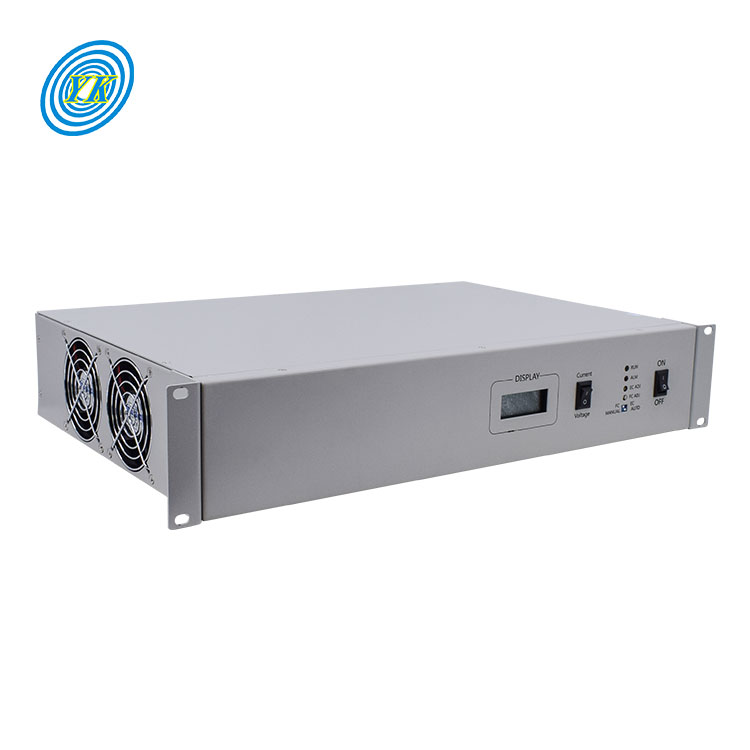
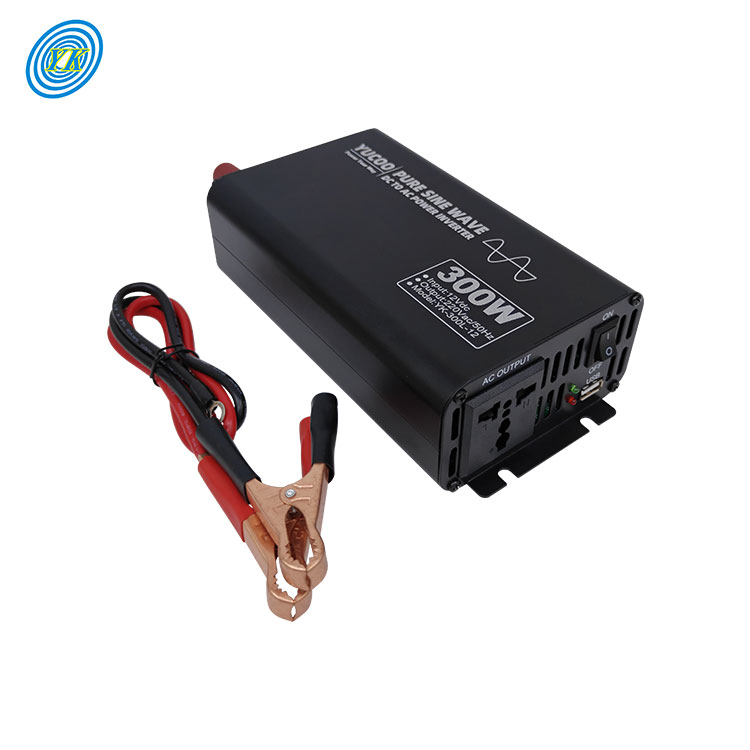
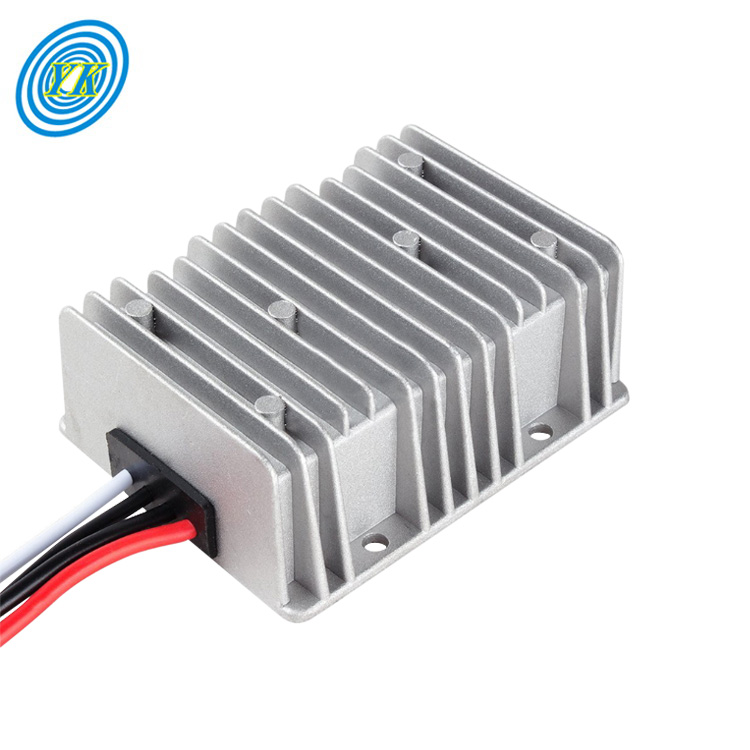
Technical Whitepaper
Topological Architectures & Synchronous Rectification Dynamics
Navigating step-down conversion in severe industrial power environments requires choosing the exact circuit architecture matching voltage delta, common-mode noise suppression, and heat dissipation requirements.
Synchronous Buck Regulators
Traditional non-synchronous buck designs utilize a freewheeling Schottky diode, which imposes an unavoidable forward voltage drop ($V_f \approx 0.45\text{V} - 0.7\text{V}$), crippling efficiency at high step-down ratios.
Our Victoria-spec buck converters replace this diode with a trench-gate low $R_{DS(on)}$ MOSFET governed by precision adaptive dead-time controllers. This curtails thermal dissipation by up to 68% and pushes system efficiency beyond 96% under sustained 20A loads.
- Low gate charge ($Q_g$) switches for >250kHz operation
- Elimination of external heatsinks in medium-power models
- Significantly lower thermal stress on electrolytic filter stages
Galvanically Isolated Step-Down
For applications where ground potential differentials, lightning strike transients, or severe DC bus floating voltages threaten sensitive logic controllers, non-isolated conversion poses catastrophic risk.
Our isolated buck series (48V, 72V, 96V to 12V) implements high-dielectric optocoupler feedback combined with dual-chamber toroidal pulse transformers, guaranteeing 1500V DC breakdown isolation between input floating grounds and secondary chassis loads.
- Zero ground loop hum in telecommunications telemetry
- Protection against high-voltage traction inverter faults
- Class-B radiated EMI compliance (AS/NZS CISPR 32)
Four-Switch Non-Inverting Buck-Boost
In heavy automotive, maritime, and solar battery storage applications, bus voltages fluctuate drastically—plunging during engine cranking (cold-crank dips to 8V) and surging during regenerative braking or solar peak charges (up to 38V).
Our four-switch proprietary synchronous topology shifts smoothly through pure Buck, Buck-Boost, and pure Boost transfer modes without discontinuous output glitching, securing an exact 12.0V or 13.8V rail regardless of battery swing.
- Seamless transition with zero hysteresis chatter
- Input surge withstand rating up to 45V for 100ms
- Ultra-low ripple ($<25\text{mV}_{p-p}$) for radio communications
Thermal Derating & Core Inductor Design Calculation for Australian Ambient Conditions
In Victoria's arid regional corridors (such as the Mallee and Loddon regions), industrial outdoor control boxes regularly achieve internal ambient temperatures exceeding +55°C. Selecting buck converters requires evaluating the maximum junction dissipation ($P_{diss}$) and maintaining inductor ripple current within the continuous conduction mode (CCM):
P_diss = [ I_out² × ( R_DS(on)_high × D + R_DS(on)_low × (1 - D) ) ] + [ V_in × I_out × f_sw × ( t_r + t_f ) / 2 ] + P_core
Where D = V_out / ( V_in × Efficiency ), and Required Inductance: L = [ (V_in - V_out) × D ] / ( ΔI_L × f_sw )
Where D = V_out / ( V_in × Efficiency ), and Required Inductance: L = [ (V_in - V_out) × D ] / ( ΔI_L × f_sw )
Our factory integrates high-permeability sendust (Fe-Si-Al) and amorphous nanocrystalline cores exhibiting near-zero magnetostriction and minimal core loss ($P_{core}$) at frequencies exceeding 200kHz, mitigating overheating under heavy regional Australian thermal envelopes.
Localized Engineering Deployments
Buck Converter Integration Across Victoria's Industrial Sectors
From the Port of Melbourne logistics terminals to the Latrobe Valley energy transition corridors, our step-down power conversion modules solve critical operational power conversion challenges throughout regional and metropolitan Victoria.
Rolling Stock & Metro Fleet Retrofits
Victoria's extensive passenger and freight rail networks utilize our galvanic isolated 72V/110V to 24V/12V buck modules. They step down high-voltage coach batteries to feed passenger Wi-Fi gateways, GPS fleet locators, and pneumatic sensor arrays, fully compliant with EN 50155 shock and vibration specifications.
Utility BESS & Solar Microgrids
Distributed Battery Energy Storage Systems (BESS) and commercial rooftop solar installations across Geelong, Bendigo, and Ballarat rely on our high-density DC-DC step-down converters to tap 48V–96V battery racks for sub-circuit PLCs, cooling fans, and SCADA remote monitoring hardware.
Agri-Tech & Precision Irrigation
Autonomous tractors, robotic fruit pickers in the Goulburn Valley, and remote telemetry stations in the Mallee require rugged, potting-encapsulated buck regulators. Our IP68 units easily endure red-dust ingestion, tractor alternator load dumps, and extreme thermal variation.
Commercial Marine & Port Infrastructure
Working vessels in Western Port Bay and Bass Strait shipping terminals use our 24V-to-12V anodized aluminum step-down regulators to protect marine navigation displays, radios, and deck radar equipment from salt spray corrosion, galvanic electrolysis, and starter surges.
Market Trends & Regulatory Shifts
Trends Driving DC-DC Converter Evolution in Victoria
Strategic modernization mandates across Victoria's electrification, telecom, and logistics frameworks have elevated standards for power density, thermal efficiency, and electromagnetic compliance.
1. Transition to 48V–96V Heavy Fleet Electrification
As industrial fleet operators across Dandenong and Campbellfield convert warehouse forklifts, municipal sweepers, and delivery vans to LiFePO4 batteries, demand has pivoted from standard 24V-12V drops to ultra-wide 48V/72V/96V-to-12V auxiliary buck regulators. These converters must tolerate abrupt regenerative spike voltages without triggering false overvoltage lockouts.
2. Stringent AS/NZS CISPR & RCM Compliance
The Australian Communications and Media Authority (ACMA) strictly penalizes electromagnetic pollution that disrupts wireless networks. Low-tier imported converters frequently emit excessive high-frequency harmonics. Our buck converters feature multi-stage common-mode chokes, π-filter networks, and grounded aluminum shielding to breeze through AS/NZS CISPR 32 Class B testing.
3. Resilient Decentralized Telecom & LEO Terminals
With rural Victorian emergency services, regional farms, and transport operators rolling out low-earth-orbit (LEO) satellite setups like Starlink Mini, auxiliary conversion has become critical. Our custom DC converters step 12V/24V service feeds cleanly into precision 30V/57V PoE lines with zero drop under extreme outback ambient temperatures.
Engineering Selection Matrix: Standard vs. Heavy-Duty Industrial Buck Converters
| Design Attribute | Commercial-Grade Buck Module | Varnix Heavy-Duty Victoria Industrial Series | Direct Engineering Advantage |
|---|---|---|---|
| Rectification Mode | Passive Schottky Diode ($V_f \approx 0.5\text{V}$) | Dual Synchronous MOSFET Trench ($R_{DS(on)} < 4.5\text{m}\Omega$) | Cuts continuous conduction losses by up to 68% |
| Operating Ambient Temp | -10°C to +45°C (Derated heavily) | -40°C to +85°C (Full load to +60°C) | Withstands closed outdoor enclosures in regional Victoria |
| Transient Suppression | Single TVS Diode or None | TVS + Metal Oxide Varistor (MOV) + Active Clamp | Immunity to ISO 7637-2 alternator load dumps |
| Potting / Protection | Partial Plastic Case or Open-Frame | Vacuum-Deaerated IP68 Silicone Gel + CNC Enclosure | 100% moisture, dust, salt-spray, and vibration proof |
| Filtering Architecture | Single Stage LC Filter | Differential + Common-Mode Dual π-Filter | Ripple reduced to $<30\text{mV}_{p-p}$; passes CISPR 32 Class B |
| Factory QA Burn-In | Sample Batch Testing only | 100% 4-Hour Dynamic Cycling Burn-In at 50°C | Virtually eliminates early infant-mortality component failures |
Verified Factory Footprint
World-Class Power Electronics Manufacturing Infrastructure
Operating continuously since 2003, our production center features 1,229m² of verified manufacturing floor space, 10+ precision lines, and comprehensive in-house quality inspection independently audited by SGS Group.
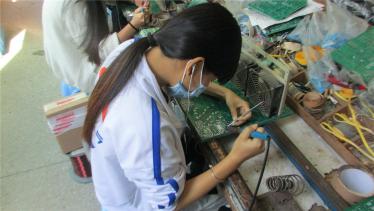
Precision SMT & Wave Soldering
Automated high-speed surface-mount placement ensures micro-millimeter precision for MOSFETs, PWM controllers, and thermal sensors.
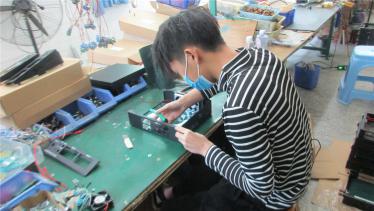
Dedicated Modular Assembly
10+ specialized assembly lines handle step-down converters, pure sine inverters, and high-amperage switching rectifiers with lean pacing.
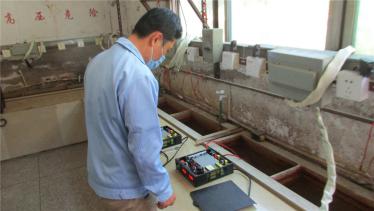
100% Dynamic Burn-In Racks
Every single buck converter undergoes a rigorous 4-hour dynamic full-load thermal chamber cycle to eliminate component early-failure risk.
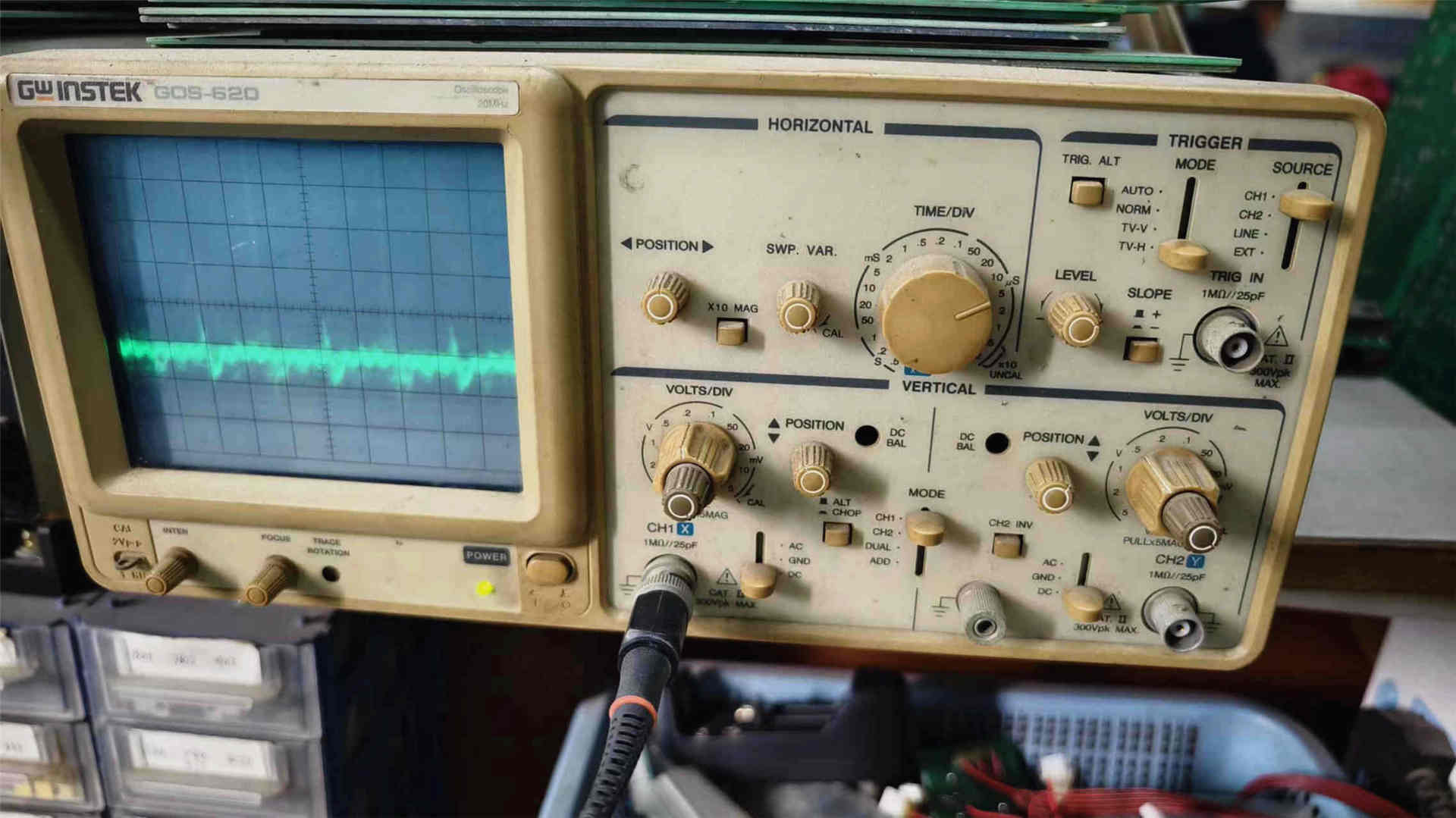
Oscilloscope & Waveform QC
Digital storage oscilloscopes inspect load transient response times, peak-to-peak ripple voltages, and switching ringing frequencies.
Bespoke Voltage Customization
Custom step-down ratios from fractional inputs (5V–120V) to non-standard outputs (e.g., 3.3V, 7.5V, 13.8V, 28V, 48V) tailored to specific OEM architectures.
Custom Housings & Pinouts
Extruded finned aluminum cases, DIN-rail clips, Deutsch/Anderson/M12 wire harnesses, and private labeling with laser-etched serial tracking.
Contract-Backed Traceability
Complete material certificates (CE, RoHS, FCC, SGS) and ISO 9001:2015 test reports provided alongside each wholesale procurement consignment.
Procurement Insights
Frequently Asked Questions by Victoria Engineers & Buyers
Get answers to common technical, logistics, compliance, and customization inquiries regarding wholesale procurement of DC-DC buck converters for Victoria and Australian territories.
Can your buck converters withstand Australian vehicle alternator load dumps? +
Yes. All our automotive and industrial buck and buck-boost modules (such as our 9-32V and 8-40V series) incorporate multi-stage input transient voltage suppression (TVS diodes and MOVs). These modules easily withstand the abrupt voltage spikes of up to 45V–60V described under ISO 7637-2 and SAE J1455 standards, commonly experienced when a vehicle battery disconnects while the alternator is charging.
How do your step-down converters maintain thermal performance in outback conditions? +
Our waterproof modules feature vacuum-injected thermally conductive organosilicon potting inside ribbed aluminum enclosures. Unlike basic epoxy resins that crack or retain localized hot spots, our potting formulation provides a thermal conductivity rating of 1.2 W/m·K. This dissipates internal heat directly to the exterior chassis, allowing continuous operation at 100% load up to +60°C ambient, with mild linear derating up to +85°C.
What are the delivery lead times for shipments into Melbourne and regional Victoria? +
Standard catalog converter inventory ships via express air freight (DHL, FedEx, UPS) directly to Melbourne (MEL) within 4 to 7 business days. For bulk containerized pallet shipments intended for regional hubs (Geelong, Ballarat, Bendigo), we ship under CIF Melbourne or DDP terms with typical sea transit schedules running 14 to 20 days. Selected high-velocity models are also stocked in our overseas warehouse hubs for expedited dispatch.
When should I specify an Isolated Buck Converter over a Non-Isolated Regulator? +
Non-isolated buck converters share a common negative ground ($GND_{in} = GND_{out}$) and deliver higher efficiency (94%–97%) at lower cost. However, you must specify an Isolated Converter (such as our 48V/72V/96V-to-12V 5A unit) when: (1) high common-mode electrical noise exists, such as near railway traction drives; (2) ground loops induce audio/RF telemetry interference; or (3) safety codes require complete galvanic disconnection (1500V DC breakdown barrier) between high-voltage battery banks and user-accessible low-voltage equipment.
Are test certificates (CE, RoHS, FCC, SGS) provided with production runs? +
Absolutely. Our facility is certified to ISO 9001:2015 and audited on-site by SGS Group. Every manufactured batch is accompanied by comprehensive Certificates of Conformance (CoC), full RoHS compliance declarations, and CE/FCC EMC test documentation required for seamless customs clearance and Regulatory Compliance Mark (RCM) certification across Australia and New Zealand.
What is the Minimum Order Quantity (MOQ) for custom voltages and OEM branding? +
For standard catalog models, our MOQ begins at just 1 to 10 units to support engineering evaluation and pilot builds. For custom OEM voltage tuning, custom wire harnesses (Anderson Powerpole, M12 connectors, Packard plugs), or private-label laser casing marking, project MOQs generally start around 50 to 100 units, backed by fast 7-day turnaround for pre-production engineering samples.
Request an Engineering Consultation & Custom Quote
Whether you require standard 24V-to-12V buck regulators or customized multi-stage isolated power modules for Victoria's harsh operating environments, our senior power electronics engineers are available to review your design schematics and bill-of-materials.